The World Order Has Broken Down
I’ve been drowning in AI anxiety lately — every day brings news of another job being automated, another model release. Then I read this 10,000-word essay by Ray Dalio (founder of Bridgewater Associates, the world’s largest hedge fund), and it snapped things into perspective: what our generation is facing isn’t just a technology revolution — it’s a full-scale restructuring of the world order.
Dalio wrote this piece after the 2026 Munich Security Conference, including a complete chapter from his book. He approaches the current moment through the lens of 500 years of historical cycles, explaining why world leaders are openly declaring the post-war order dead. The most striking example: the causal chain behind Japan’s attack on Pearl Harbor — the US cut off 80% of Japan’s oil supply, Japan calculated it would run out within two years, and chose to attack. Now look at the chip export controls and economic sanctions between the US and China today. The same pattern appears to be repeating.
This is a long piece. I’ve added editorial commentary before each major section — context, background knowledge, and connections to current events — to make it more digestible. If you’ve been feeling overwhelmed by information anxiety, take some time to zoom out and see what’s really happening at the macro level.
Reading guide: This essay begins at the 2026 Munich Security Conference — the world’s most important security forum. Dalio notes that the German Chancellor, French President, and US Secretary of State all independently declared: the post-WWII world order is over.
Background: The “post-1945 world order” refers to the entire international system built under US leadership after WWII: the UN for collective security, Bretton Woods for a dollar-centered monetary order, GATT/WTO for international trade, NATO for Western military alliance. This system maintained roughly 80 years of relative peace — a rare period of extended stability in human history.
Connecting to now: Dalio uses his “Big Cycle” framework to place the current moment in “Stage 6” — a period of chaos where rules break down and great powers collide. He then shares the full Chapter 6 from his book to explain how this stage works.
At the Munich Security Conference, the post-1945 world order was pronounced dead by most leaders and the picture behind it was laid out in the Security Report 2026, entitled “Under Destruction.” More specifically, German Chancellor Friedrich Merz said, “The world order as it has stood for decades no longer exists,” and that we are in a period of “great power politics.” He made clear that freedom “is no longer a given.” French President Emmanuel Macron echoed this assessment, pointing out that Europe’s old security structures tied to the previous world order don’t exist and that Europe must prepare for war. US Secretary of State Marco Rubio said that we are in a “new geopolitics era” because the “old world” is gone.
In my parlance, we are in the Stage 6 part of the Big Cycle — a period of great disorder where there are no rules, might is right, and great powers collide. How Stage 6 works is explained in detail in Chapter 6, “The Big Cycle of External Order and Disorder,” in my book Principles for Dealing with the Changing World Order. Given that nearly everyone now agrees the post-1945 world order has broken down and that we are entering a new world order, I think it would be worth your time to read this chapter. Here it is in full.
Chapter 6: The Big Cycle of External Order and Disorder
Reading guide: This section is the theoretical foundation of the entire essay. Dalio’s core argument is simple: within nations, there are laws, police, and judges to maintain order. Between nations, there are none. The UN is ineffective because its power is less than that of the US or China. So international relations are fundamentally governed by the “law of the jungle” — whoever has the bigger fist makes the rules.
Background: This perspective belongs to the “Realist” school of international relations, whose key thinkers include Morgenthau and Mearsheimer. The opposing “Liberal” school argues that international institutions and economic interdependence can constrain great power behavior. Dalio clearly stands with the Realists.
Relationships between people and the orders that govern them work in basically the same ways, whether they are internal or external, and they blend together. In fact, it wasn’t long ago that there were no distinctions between internal and external orders because there were no clearly defined and mutually recognized boundaries between countries. For that reason, the six-stage cycle of going between order and disorder that I described in the last chapter about what happens within countries works the same way between countries, with one big exception: international relations are driven much more by raw power dynamics .
That is because all governance systems require effective and agreed-upon: 1) laws and law-making abilities, 2) law enforcement capabilities (e.g., police), 3) ways of adjudicating (e.g., judges), and 4) clear and specified consequences that both suit crimes and are enforced (e.g., fines and incarcerations). These things either don’t exist or are not as effective between countries as they are within them. While attempts have been made to make the external order more rule-abiding (e.g., via the League of Nations and the United Nations), they have by and large failed because these organizations have not had more wealth and power than the most powerful individual countries. When individual countries have more power than the collectives of countries, the more powerful individual countries rule.
That is why power prevails, and wealth and power among equals is rarely given up without a fight. When powerful countries have disputes, they don’t get their lawyers to plead their cases to judges. Instead, they threaten each other and either reach agreements or fight. The international order follows the law of the jungle much more than it follows international law.
Reading guide: Next, Dalio defines five types of conflict between nations. This classification framework is the skeleton of the entire essay — every historical case that follows maps back to these five types.
Connecting to now: Consider the current situation — all five types of conflict are already happening between the US and China: trade war (tariffs), tech war (chip export controls, CHIPS Act), capital war (restrictions on investment in China), geopolitical war (Taiwan Strait, South China Sea). The only one that hasn’t happened yet is the fifth — military war.
There are five major kinds of fights between countries: trade/economic wars, technology wars, capital wars, geopolitical wars, and military wars. Briefly defined:
- Trade/economic wars: Conflicts over tariffs, import/export restrictions, and other ways of damaging a rival economically
- Technology wars: Conflicts over which technologies are shared and which are held as protected aspects of national security
- Geopolitical wars: Conflicts over territory and alliances, resolved through negotiations and explicit or implicit commitments, not fighting
- Capital wars: Conflicts imposed through financial tools such as sanctions (cutting off money and credit) and limiting foreign access to capital markets
- Military wars: Conflicts that involve actual shooting and the deployment of military forces
Most fights between nations fall under one or more of those categories (cyber warfare, for example, has a role in all of them). These conflicts are over wealth, power, and the ideologies pertaining to them. While most types don’t involve shooting and killing, they are all power struggles. In most cases, the first four kinds of war will evolve over time as intense competitions between rival nations until a military war begins . Once a military war starts, all four other dimensions are weaponized to the greatest extent possible.
As discussed in the previous chapters, all of the factors that drive internal and external cycles tend to improve and worsen together. When things get bad, there are more things to argue over, which leads to greater inclinations to fight. That’s human nature, and it is why we have the Big Cycle — which oscillates between good times and bad ones.
- All-out wars typically occur when existential issues — ones so essential to a country’s existence that people are willing to fight and die for them — are at stake and cannot be resolved by peaceful means. The wars that result make it clear which side has supremacy, and that clarity over who sets the rules becomes the basis of a new international order.
Reading guide: The chart below shows 500 years of conflict cycles in Europe. Three big cycles, each roughly 150 years: periods of peace and prosperity (Renaissance, Enlightenment, Industrial Revolution) sow the seeds of war, eventually erupting into large-scale conflict (Thirty Years’ War, Napoleonic Wars, World Wars). What Dalio wants you to see: peace is not the norm — it’s one phase of a cycle.
The following chart shows the cycles of internal and external peace and conflict in Europe going back to 1500, as reflected in the deaths they caused. There were three big cycles of rising and declining conflict, averaging about 150 years each. Though big civil and external wars last only a short time, they are typically the culmination of longstanding conflicts that led up to them. While World Wars I and II were separately driven by the classic cycle, they were also interrelated.
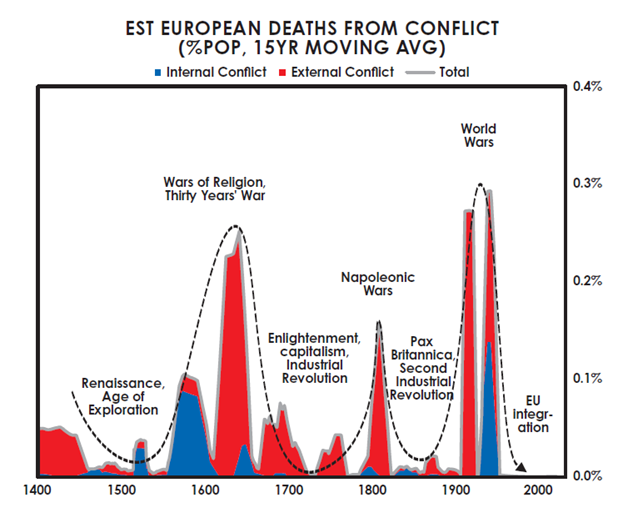
Each cycle consisted of a relatively long period of peace and prosperity (e.g., the Renaissance, the Enlightenment, and the Industrial Revolution) that sowed the seeds for terrible and violent external wars (e.g., the Thirty Years’ War, the Napoleonic Wars, and the two World Wars). Both the upswings (peace and prosperity) and the downswings (depression and war) affected the whole world. Not all countries prosper when the leading powers do, because countries gain at the expense of others. For example, China’s decline from around 1840 to 1949 — the “Century of Humiliation” — came about because the Western powers and Japan exploited China.
As you read on, keep in mind that
It is for those reasons that so many of the principles that follow are about ways to avoid shooting wars. Still, whether they are fought for good reasons or bad, shooting wars happen. While I believe most are tragic and fought for nonsensical reasons, some are worth fighting because the consequences of not fighting them (e.g., the loss of freedom) would be intolerable.
The Timeless Forces That Drive Changes to the External Order
Reading guide: This is the most important theoretical section of the entire essay. Dalio will lay out several key principles: when war risk is highest, how to pursue win-win outcomes, why “stupid wars” still happen, and how to use power wisely.
Background: “Guns and butter” is a classic economics metaphor from WWII — a country must allocate limited resources between military spending (guns) and civilian welfare (butter). Dalio’s argument: truly successful countries can afford both, but no country can do it forever. He also references the “prisoner’s dilemma” — game theory’s most famous model, where two rational actors end up betraying each other even though cooperation would make both better off, because neither trusts the other.
As I explained in Chapter 2, after self-interest and self-survival, the quest for wealth and power is what most motivates individuals, families, companies, states, and countries. Because wealth equals power — it determines the ability to build military strength, control trade, and influence other nations — domestic and military strength go hand in hand. It takes money to buy guns (military power) and it takes money to buy butter (domestic social spending needs). When a country fails to provide adequate amounts of either, it becomes vulnerable to domestic and foreign opposition.
From my study of Chinese dynasties and European empires, I’ve learned that the financial strength to outspend one’s rivals is one of a country’s most important strengths. That is how the United States beat the Soviet Union in the Cold War. Spend enough money in the right ways, and you don’t have to fight. Long-term success depends on sustaining both “guns” and “butter” without producing the excesses that lead to decline. The really successful countries have been able to do this for 200 to 300 years . But none has been able to do it forever . Conflict arises when the dominant power begins to weaken, or an emerging power begins to approach its strength — or both.
As of this writing, the most potentially explosive conflict is that between the United States and China over Taiwan . The choice that opposing countries face — either fighting or backing down — is extremely hard to make. Both are costly: fighting in terms of lives and money, backing down in terms of lost status, since it shows weakness, which leads to reduced support. When two competing entities each have the power to destroy the other, both must have extremely high trust that the other won’t cause unacceptable harm. However, managing the prisoner’s dilemma successfully is extremely rare.
While there are no rules in international relations other than those the most powerful impose on themselves, some approaches produce better outcomes than others. Specifically, those more likely to lead to win-win outcomes are better than those that lead to lose-lose outcomes. Hence this all-important principle:
Skilled collaborations to produce win-win relationships — ones that both increase and divide up wealth and power well — are much more rewarding and much less painful than wars that lead to one side subjugating the other. Seeing things through your adversary’s eyes, clearly identifying and communicating your red lines to them, are the keys to doing this well.
But “stupid wars” still happen all the time. It is far too easy to slip into stupid wars because of: a) the prisoner’s dilemma, b) a tit-for-tat escalation process, c) the perceived costs of backing down for the declining power, and d) misunderstandings existing when decision making has to be fast. Rival great powers typically find themselves in the prisoner’s dilemma; they need ways of assuring the other that they won’t strike first, lest the other strikes first. Tit-for-tat escalations are dangerous because each side must escalate or lose what the enemy captured in the last move — like a game of chicken, push it too far and there’s a head-on crash. Untruthful and emotional appeals that rile people up increase the danger of stupid wars, so it’s better for leaders to be truthful and thoughtful in explaining the situation. The worst thing is when leaders are untruthful and emotional with their populations, and worse still when they take over the media.
By and large, the tendency to move between win-win and lose-lose relationships happens cyclically. People and empires are more likely to cooperate during good times and fight during bad times. When the existing great power is declining relative to a rising power, it naturally tends to want to maintain the status quo, while the rising power wants to change the rules to match changing realities.
While I don’t know about the love part of “all is fair in love and war,” I know the war part is right. In the American Revolutionary War, the British lined up in rows for the fight and the revolutionaries shot at them from behind trees. The British thought it was unfair and complained. The revolutionaries won, believed the British were foolish, and the cause of independence and freedom justified changing the rules of war. That’s just how it is. This leads to one final principle:
Reading guide: Dalio now expands on “how to use power wisely.” His argument has several layers: hard power isn’t always best; soft power is often more effective. Power is like a hidden knife — keep it sheathed normally, draw it only when you must. And a counterintuitive point: having power you don’t need is actually a burden, because maintaining power consumes resources.
Background: “Soft power” was coined by Harvard professor Joseph Nye in 1990, referring to the ability to influence others through culture, values, and institutional attractiveness rather than military or economic coercion. Dalio implicitly echoes this concept here.
Having power is good because power will win out over agreements, rules, and laws. When push comes to shove, those who have the power to enforce their interpretation of the rules — or overturn them — get what they want. Respecting power is important because it’s not smart to fight a war you’re going to lose; better to negotiate the best settlement possible (unless you want to be a martyr, which is usually for stupid ego reasons rather than sensible strategy).
Using power wisely doesn’t necessarily mean forcing others to give you what you want — i.e., bullying. It includes recognizing that generosity and trust are powerful forces for producing win-win relationships. In other words, using “hard powers” is often not the best path; using “soft powers” is preferable.
When thinking about how to use power wisely, deciding when to reach an agreement and when to fight is critical. To do that, one must imagine how one’s power will change over time. It is desirable to negotiate, enforce agreements, or fight when one’s power is greatest. If relative power is declining, fighting early is better; if rising, fighting later is better.
Handling power is usually best done without showing it, because showing it typically leads others to feel threatened and build their own threatening powers, leading to mutual escalation. Power is usually best handled like a hidden knife that can be brought out in the event of a fight. But there are times when showing power and threatening to use it are most effective for improving one’s negotiating position and preventing conflict.
Knowing what matters most and least to the other party, especially what they will and won’t fight for, allows you to work toward an equilibrium both parties consider fair. Though having power is generally desirable, having power you don’t need is not — because maintaining power consumes resources, especially time and money. And with power comes the burden of responsibilities. I have often been struck by how much happier less powerful people can be relative to more powerful people.
Case Study: World War II
Reading guide: From here, Dalio moves into historical case studies. He chose WWII not because it’s the most interesting, but because it most completely demonstrates how three cycles interweave: the money/credit cycle (money printing, debt), the internal order cycle (wealth conflict, populism), and the external order cycle (great power rivalry). His subtext is clear: the 1930s and today share striking similarities — economic war is already underway, and military war is not impossible.
Connecting to now: Consider the parallels: post-Depression protectionism → the US-China tariff war since 2018; 1930s technology blockades → chip export controls since 2022; 1930s capital warfare → SWIFT sanctions and frozen central bank assets targeting Russia. History doesn’t repeat, but it rhymes.
We’ve covered the dynamics and principles that drive the external order and disorder cycle. Now I’d like to briefly look at the World War II case because it provides the most recent example of the classic dynamic of going from peace to war. Though it is only one case, it clearly shows how the confluence of the three big cycles — the money and credit cycle, the internal order/disorder cycle, and the external order/disorder cycle — created the conditions for a catastrophic war and laid the groundwork for a new world order.
The stories from this period are interesting in themselves, but they are especially important for the lessons they provide about what is happening now and what might lie ahead. Most importantly, the United States and China are in an economic war that could conceivably evolve into a military war, and the 1930s comparison provides valuable insights.
The Path to War
Reading guide: What follows is how the 1929 Great Depression pushed the world toward war. The core logic chain: economic collapse → wealth conflict → populist leaders rise → authoritarian regimes. Different countries went to different extremes: Germany, Japan, Italy, and Spain turned fascist (far-right); the USSR and China turned communist (far-left); the US and UK, with stronger democratic traditions, didn’t go as far.
I’ll quickly run through the geopolitical highlights from the pre-war period through the official start of war in Europe in 1939 and Pearl Harbor in 1941, then move through the war and the establishment of the new world order in 1945 — with the US at the peak of its power.
The global depression that followed the Great Crash of 1929 led to almost all countries having severe internal conflicts over wealth. This caused them to turn to more populist, autocratic, nationalistic, and militaristic leaders and policies. These shifts went either right or left, in varying degrees, depending on each country’s circumstances and the strength of their democratic or autocratic traditions. In Germany, Japan, Italy, and Spain, extremely bad economic conditions and less established democratic traditions led to extreme internal conflicts and a turn to populist/autocratic leaders of the right (fascists). At different points, the Soviet Union and China — which also endured extreme conditions and had no experience with democracy — turned to populist/autocratic leaders of the left (communists). The US and UK had much stronger democratic traditions and less severe economic conditions, so they became more populist and autocratic than before, but not nearly as much as other nations.
Germany and Japan
Reading guide: Hitler’s rise is a textbook case of “economic crisis → authoritarian rule.” Note Dalio’s analytical angle — he’s not just telling a history story, he’s demonstrating a pattern: humiliation + economic collapse + left-right conflict → strongman rises → fiscal stimulus rebuilds economy → military buildup. And he points out the uncomfortable but important observation: from a purely economic standpoint, Hitler’s policies “worked” — unemployment dropped from 25% to zero, GDP grew 8% annually.
Background: The “gold standard” refers to a monetary system where currency is pegged to gold and convertible at a fixed rate. Abandoning the gold standard allows governments to print money freely — a short-term economic stimulant, but also opens the door to currency devaluation. Japan was forced off the gold standard in 1931; the US followed in 1933. “Monetizing debt” means the central bank prints money to buy government bonds — essentially using the printing press to fund government spending.
While Germany had been saddled with tremendous reparation debts after WWI, by 1929 it was beginning to emerge through the Young Plan, which provided considerable debt relief and the departure of foreign troops by 1930. But the global depression hit Germany hard, leading to nearly 25% unemployment, massive bankruptcies, and widespread poverty. As is typical, there was a struggle between populists of the left (communists) and the right (fascists).
Hitler, the leading populist/fascist, tapped into national humiliation to build a nationalistic furor, casting the Treaty of Versailles and the countries that imposed it as the enemy. He created a 25-point nationalistic program and rallied support. In response to internal fighting and the desire to restore order, Hitler was appointed chancellor in January 1933, drawing large support from industrialists who feared the communists. Two months later, the Nazi Party won the most seats in the Reichstag. Hitler refused to pay any further reparations, left the League of Nations, and took autocratic control of Germany in 1934, becoming the country’s supreme leader.
In democracies there are always some laws that allow leaders to grab special powers; Hitler seized them all. He invoked Article 48 of the Weimar Constitution to end many civil rights and suppress the communists, forced through the Enabling Act allowing him to pass laws without the Reichstag and the president, censored or took control of media, created the Gestapo, deprived Jews of citizenship, seized Protestant Church finances, and declared Aryan racial supremacy.
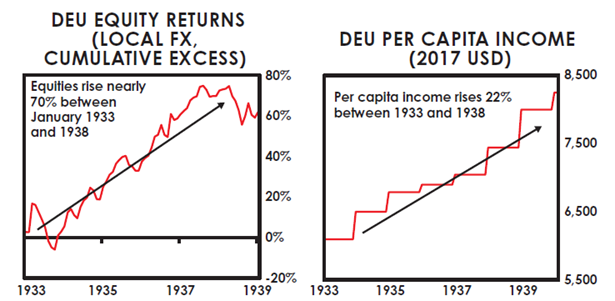
Hitler took that same autocratic/fascist approach to rebuilding Germany’s economy with massive fiscal and monetary stimulation. He privatized state-owned businesses, encouraged corporate investment, and raised Aryan Germans’ living standards — creating Volkswagen for affordable cars and directing the Autobahn’s construction. He financed this spending by forcing banks to buy government bonds. The resulting debts were paid back by corporate earnings and the Reichsbank monetizing debt.
The economic effects: when Hitler came to power in 1933, unemployment was 25% . By 1938, it was zero . Per capita income increased 22% in five years, and real growth averaged over 8% per year between 1934 and 1938. German equities rallied nearly 70% between 1933 and 1938, until the hot war began.
Reading guide: Next is Japan’s story. Similar pattern to Germany, but with different causes: Japan is an island nation lacking natural resources, with an economy highly dependent on exports. Exports collapsed 50% → forced off the gold standard → currency crashed → right-wing militarism rose → decided to seize resources by force. Dalio also defines the three core characteristics of fascism.
In 1935, Hitler began building the military, making service compulsory for Aryans. Germany’s military spending grew far faster than any other country because its economy needed more resources, and it intended to use military power to seize them.
Like Germany, Japan was hit exceptionally hard by the depression and became more autocratic in response. As an island nation without adequate natural resources, Japan relied on exports to import necessities. When its exports fell by around 50% between 1929 and 1931, Japan was devastated. In 1931, Japan went broke — forced to draw down its gold reserves, abandon the gold standard, and float its currency, causing a massive depreciation and loss of buying power.
By 1932, there was a massive upsurge in right-wing nationalism and militarism. Japan set out to seize the natural resources (oil, iron, coal, rubber) and human resources (slave labor) it needed by invading Manchuria in 1931 and expanding through China and Asia.
In 1934, severe famine in parts of Japan caused more political turbulence, reinforcing the right-wing, militaristic, nationalistic, and expansionistic movement. Japan’s top-down fascist command economy grew stronger, building a military-industrial complex. As with Germany, most Japanese companies remained privately held, but their production was government-controlled.
What is fascism? A country makes three big governance choices: 1) bottom-up (democratic) or top-down (autocratic) decision making; 2) capitalist or communist (socialist in the middle) ownership of production; 3) individualistic (individual well-being first) or collectivist (collective well-being first). Fascism is: **autocratic + capitalist + collectivist** . Fascists believe that top-down leadership, where government directs private enterprise and individual gratification is subordinated to national success, is the best way to make a country wealthier and more powerful.
The US and the Allies
Reading guide: America’s response demonstrates a different path. Great Depression → banking crisis → protectionism (the 1930 tariff act made the global situation worse) → Roosevelt took office and printed money aggressively, expanded spending, and imposed heavy taxes on the wealthy (top rate went from 25% to 81%). Strong economic rebound (stocks up 200%, GDP growing 9% annually), but in 1936 the Fed tightened too early, triggering another recession. Dalio packs several key principles into this section.
Connecting to now: Note Dalio’s assessment of tariffs — he says they “protected specific industries but made the global economy weaker.” This was written in 2026, as the global tariff war of 2025 was still fresh. It reads with particular resonance.
In the US after 1929, debt problems became ruinous for banks, which curtailed lending globally, hurting international borrowers. At the same time, the depression created weak demand, leading to a collapse in US imports and other countries’ exports. Weakening incomes, falling demand, and more credit problems created a self-reinforcing downward spiral.
The US responded by turning protectionist, raising tariffs via the 1930 Smoot-Hawley Tariff Act, which further depressed other countries’ economies.
The Soviet Union had yet to recover from its devastating 1917–22 revolution, civil war, and 1921 famine, and was wracked by political purges and economic hardships throughout the 1930s. China suffered from civil war, poverty, and famine in 1928–30. When things worsened in 1930 and tariffs began, bad became desperate. To make matters worse, droughts struck both the US and the Soviet Union in the 1930s.
Under extreme government policies, millions died in the USSR. Internal political fighting and fears of Nazi Germany led to purges of hundreds of thousands — accused of spying and shot without trials.
In the US, it took three and a half years — from the October 1929 crash to Roosevelt’s March 1933 actions. In his first 100 days, Roosevelt created several massive spending programs funded by big tax increases and budget deficits financed by Federal Reserve-monetized debt. He instituted jobs programs, unemployment insurance, Social Security, and labor-friendly policies. After his 1935 “Soak the Rich Tax,” the top marginal income tax rate rose to 75% (versus 25% in 1930). By 1941, the top personal rate was 81% and the top corporate rate was 31% (up from 12% in 1930). Despite all these taxes and economic recovery-driven revenue growth, deficits increased from ~1% of GDP to ~4% because spending increases were so large.
From 1933 to late 1936, the stock market returned over 200% , and the economy grew at an average real rate of about 9% . In 1936, the Fed tightened money and credit to fight inflation and cool an overheating economy, which caused the fragile US economy to fall back into recession, further raising tensions within and between countries.
Meanwhile in Europe, the conflict between left-wing populists (communists) and right-wing populists (fascists) in Spain flared into the brutal Spanish Civil War. Franco, with Hitler’s support, successfully purged the left-wing opposition.
In the US and UK, while there were redistributions of wealth and political power, capitalism and democracy were maintained. In Germany, Japan, Italy, and Spain, they were not.
Reading guide: Next, Dalio lists the three weapons of economic warfare. This is highly practical — these are the exact same tools used today. The 2022 Western sanctions against Russia were a combined deployment of all three: freezing Russian central bank assets (asset freeze), cutting Russian banks from SWIFT (blocking capital markets access), oil embargo and export controls (embargoes).
Before all-out wars are declared, there is typically about a decade of economic, technological, geopolitical, and capital wars, during which the conflicting powers intimidate each other, testing each other’s limits. While 1939 and 1941 are known as the official starts of the European and Pacific wars, the conflicts really began about ten years before that .
Before describing the hot war, I want to detail the common tactics used when economic and capital tools are weaponized. They have been and still are:
- Asset freezes/seizures: Preventing an enemy from using or selling foreign assets they rely on. These range from targeted group asset freezes (e.g., current US sanctions on Iran’s Revolutionary Guard) to more severe measures like unilateral debt repudiation or outright seizures.
- Blocking capital markets access: Preventing a country from accessing capital markets (e.g., in 1887, Germany banned purchases of Russian securities and debt to impede Russia’s military buildup).
- Embargoes/blockades: Blocking trade in goods and/or services to weaken a country or prevent it from getting essentials (e.g., the US oil embargo on Japan and closing the Panama Canal to Japanese ships in WWII), or blocking a country’s exports to cut its income.
The Hot War Begins
Reading guide: From here it’s the actual course of the war. Note two parallel threads: the European theater (Hitler’s expansion → invasion of Poland → blitzkrieg across Western Europe → invasion of the USSR into a costly two-front war) and the Pacific theater (Japan’s occupation of China → the Nanjing Massacre → expansion into Southeast Asia for resources). The US played the role of gradually shifting from “bystander” to “participant” in both.
Background: The Lend-Lease Act was America’s most important form of intervention before formally entering the war — nominally “lending” or “leasing” materiel to allies, though much of it was never returned or paid for. This let the US support the Allies without a formal declaration of war, while simultaneously stimulating the domestic economy.
In November 1937, Hitler secretly met his top officials to announce plans for German expansion — seizing resources and uniting the Aryan race. He then acted, first annexing Austria, then seizing oil-rich parts of Czechoslovakia. Europe and the US watched warily, not wanting another war so soon after WWI’s devastation.
As with all wars, the unknowns far exceeded the knowns because a) rival powers only go to war when their powers are roughly comparable (otherwise it’s suicidal for the weaker side), and b) there are too many possible actions and reactions to anticipate. The only thing known at the outset of a hot war is that it will probably be extremely painful. So smart leaders typically go into war only when the other side has pushed them into a position of either fighting or losing by backing down. For the Allies, that moment came on September 1, 1939, when Germany invaded Poland.
Germany looked unstoppable, quickly capturing Denmark, Norway, the Netherlands, Belgium, Luxembourg, and France, and strengthening alliances with Japan and Italy. By seizing territory rapidly (e.g., oil-rich Romania), Hitler’s army conserved existing oil resources and gained new ones. The thirst for natural resources remained a major driver of the Nazi war machine. War with the Soviets was inevitable; the only question was when. Despite a non-aggression pact, Germany invaded Russia in June 1941, entering an extremely costly two-front war.
In the Pacific in 1937, Japan expanded its occupation of China, brutally taking Shanghai and Nanking, killing an estimated 200,000 civilians and disarmed combatants in Nanking alone. While the US remained isolationist, it provided Chiang Kai-shek’s government with fighter planes and pilots, putting a toe in the war. US-Japan conflicts began to escalate — a Japanese soldier struck the US consul in Nanking, and Japanese fighter planes sank a US gunboat.
Reading guide: What follows is how the US was gradually pushed into the war. This is a classic case of “economic sanctions → force the other side to choose → war erupts.” The US froze Japanese assets, embargoed oil, and closed the Panama Canal → cutting off 3/4 of Japan’s trade and 80% of its oil → Japan calculated it would run out of oil within two years → forced to choose between retreat and attacking the US → chose to attack Pearl Harbor. This perfectly matches Dalio’s earlier theory: economic war backs the opponent into a corner, eventually triggering military war.
In November 1940, Roosevelt won re-election after promising to keep the US out of war, even though the US was already taking economic action to protect its interests. Earlier in 1940, Secretary of War Stimson had initiated aggressive economic sanctions against Japan, culminating in the 1940 Export Control Act. The US moved the Pacific Fleet to Hawaii. In October, the US escalated the embargo, restricting “all iron and steel to destinations other than Britain and nations of the Western Hemisphere.” The plan: cut Japan off from resources to force their retreat from occupied territories.
In March 1941, Congress passed the Lend-Lease Act, allowing the US to lend or lease war supplies to nations it deemed “vital to the defense of the United States” — including Great Britain, the Soviet Union, and China. Helping the Allies was good for the US both geopolitically and economically. But its motivations weren’t entirely mercenary: Britain was running out of gold, so the US allowed deferred payment (in some cases waiving it entirely). Though not a formal declaration of war, Lend-Lease effectively ended US neutrality.
France, the Netherlands, and Great Britain all had Asian colonies. Overstretched by the European fighting, they couldn’t defend them against Japan. Starting in September 1940, Japan invaded several Southeast Asian colonies, beginning with French Indochina, adding them to its “Greater East Asia Co-Prosperity Sphere.” In 1941, Japan seized Dutch East Indies oil reserves, threatening US Pacific interests.
In July and August 1941, Roosevelt responded — freezing all Japanese assets in the US, closing the Panama Canal to Japanese ships, and embargoing oil and gas exports to Japan. This cut off three-fourths of Japan’s trade and 80% of its oil. Japan calculated it would run out of oil within two years . This forced Japan to choose between backing down and attacking the US.
On December 7 and 8, 1941, Japan launched coordinated attacks on US forces at Pearl Harbor and in the Philippines. This marked the beginning of the Pacific war and brought the US into the European war as well. Japan didn’t have a widely recognized plan for victory, but the most optimistic Japanese leaders believed the US would lose because it was fighting on two fronts and because its individualistic/capitalist system was inferior to Japan and Germany’s authoritarian/fascist systems. They also believed they had a greater willingness to die for their country — a big driver of which side wins.
Wartime Economic Policies
Reading guide: This section covers how governments control economies during total war. The core message: once all-out war begins, the government controls everything — what gets produced, what can be bought and sold (rationing), imports and exports, prices, wages, whether you can access your own money, whether you can move money abroad. International transactions revert to gold because no one trusts wartime currencies. The two charts that follow show each country’s economic and market controls.
Connecting to now: These measures still apply in modern warfare. After the 2022 Russia-Ukraine war began, Russia imposed capital controls (limiting ruble conversion), the West froze approximately $300 billion in Russian central bank assets, and SWIFT sanctions cut financial links. Dalio’s framework helps you understand the logic behind these news headlines.
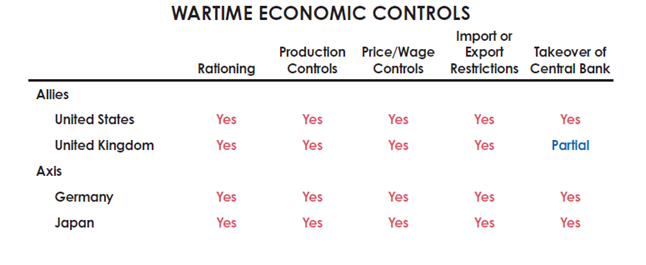
Just as it’s worth noting classic economic war tactics, it’s worth noting classic wartime domestic economic policies. These include government controls on nearly everything as the country shifts resources from profit-making to war-making — e.g., the government determines a) what items can be produced, b) what can be bought and sold in what amounts (rationing), c) what can be imported and exported, d) prices, wages, and profits, e) access to one’s own financial assets, and f) the ability to move money out of the country. Because wars are expensive, classically the government g) issues lots of debt that is monetized, h) relies on non-credit money such as gold for international transactions because its credit isn’t accepted, i) governs more autocratically, j) imposes various economic sanctions on enemies including cutting off capital access, and k) has enemies impose these same sanctions on them.
After the US entered the war following Pearl Harbor, most countries implemented classic wartime economic policies. The following table shows economic controls in each major country.
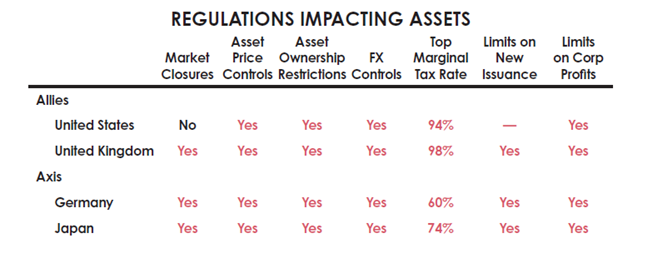
Market movements during the hot war years were heavily affected by both government controls and how countries performed in battles, as the odds of winning and losing shifted. The next table shows the controls over markets and capital flows put in place by major countries during the war years.
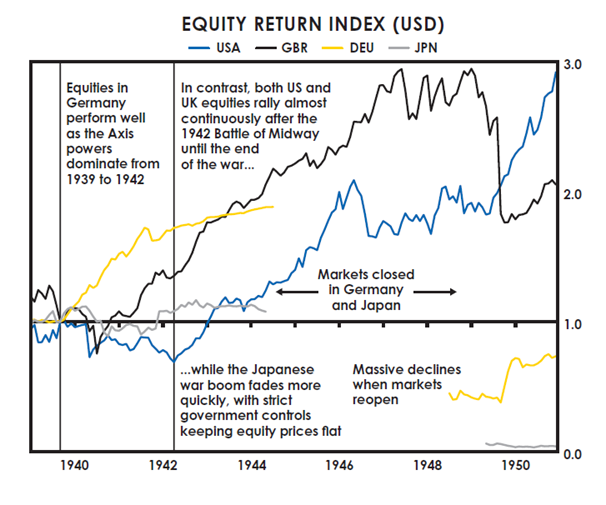
Reading guide: The final section covers wartime stock market performance. The core insight: during war, stock markets no longer reflect economic fundamentals — they reflect the probability of winning or losing. German stocks rose as Germany swept through Europe; the 1942 Battle of Midway became the turning point, after which Allied stocks climbed while Axis stocks declined. German and Japanese markets closed after the war for five years and reopened nearly wiped out. Dalio ends with blunt investment advice: sell all bonds, buy gold.
Stock market closures were common, leaving investors without access to capital. Money and credit were not commonly accepted between non-allied countries during the war, for justifiable reasons about whether currencies would retain any value. Gold — or in some cases silver or barter — was the coin of the realm during wars. Prices and capital flows were typically controlled, making it difficult to determine real prices.
Because losing wars typically leads to a total wipeout of wealth and power , movements of stock markets that remained open were largely driven by how countries performed in key battles, as results shifted the probability of victory or defeat. German equities outperformed early in WWII as Germany captured territory, then underperformed after the Allies turned the tide. After the 1942 Battle of Midway, Allied equities rallied almost continuously until war’s end, while Axis equities were flat or down. Both the German and Japanese stock markets closed at the war’s end, didn’t reopen for about five years , and were virtually wiped out when they did, while US stocks were extremely strong.
Protecting wealth in wartime is difficult — normal economic activities are curtailed, traditionally safe investments aren’t safe, capital mobility is limited, and heavy taxes are imposed when people and countries are fighting for survival. Protecting the wealthy is not a priority; redistributing wealth to where it’s needed most is. As for investment advice: **sell out of all debt and buy gold** — because wars are financed by borrowing and printing money, which devalues debt and currency, and there is a justifiable reluctance to accept credit.
Conclusion
Reading guide: Dalio’s ending is restrained, but the message is clear: all great powers eventually decline, but decline doesn’t have to be catastrophic. If a country can stay productive, live within its means, make its system work for most of its people, and maintain win-win relationships with its major rivals — it has a chance to extend prosperity and avoid catastrophic collapse. Read the whole piece, and you’ll see this isn’t just a history lesson — it’s a warning and a guide.
Every world power has its time in the sun, thanks to the uniqueness of their circumstances and the nature of their character and culture (e.g., strong work ethic, smarts, discipline, education), but they all eventually decline. Some do so more gracefully, with less trauma, but they decline nonetheless. Traumatic declines can lead to some of the worst periods in history, when fights over wealth and power prove extremely costly both economically and in human lives. Still, the cycle needn’t transpire this way if countries in their rich and powerful stages stay productive, earn more than they spend, make the system work well for most of their populations, and find ways to create and sustain win-win relationships with their most significant rivals. A number of empires and dynasties have sustained themselves for hundreds of years, and the United States, at 245 years old, has proven itself one of the longest-lasting.